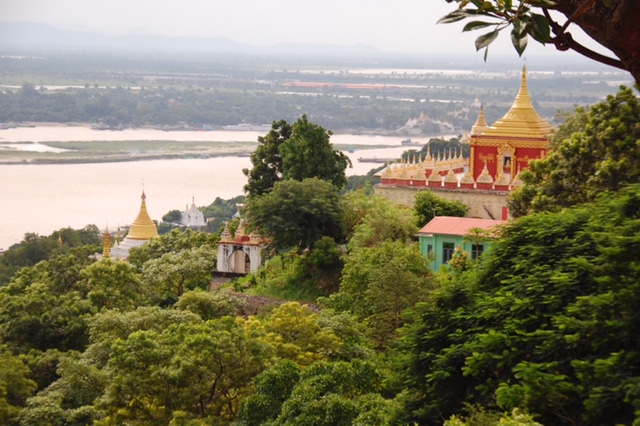
As I journey through beautiful Myanmar, once more I am faced with the contradictions and hypocrisy that I’m probably a part of. It’s the same feeling as when I am in Zimbabwe, South Africa, Saudi or even cycling through Europe. As I cycled through Slovakia and Hungary this summer, I realised that I must have been on the path that thousands of refugees had been walking through earlier seeking to escape Syria. But the unease of visiting as a tourist is as always partly offset by the people you meet who desperately tell you how pleased they are that you are there and please tell your friends and family about how it really is!
And so now in Myanmar, I can afford to have a guide around the historical monuments of the Irrawaddy flood plain. I can afford to stay in very beautiful hotels. And then I sit in my room and watch BBC World coverage of the Rohinga crisis in the Rakine province. Same country but different worlds. One thing that distinguishes the Burmese people is their open smile and hospitality. So how then in what appears such a peaceful if at times chaotic country, can such prejudice and oppression and as some would describe it – genocide- take place.
Conversations with people over the last week, has helped me understand this and the complicated politics and Buddhist spiritualism in this country. It reminded me of what we talk about a lot in Kunskapsskolan – bildning. It’s very hard to translate, but basically describes the learning journey to being an education person. Someone who can weight uip all the evidence before making decisions and looks in depth at reasons realising that these are often contradictory and ambiguous. Life is complicated. It is often grey, not black and white.
So how could someone like Aun Sang Suu Kyi as a a Nobel Peace Prize winner preside over such human misery. Surely the assassination of her father and years of house arrest and deprivation from family life make her more sensitive to what is going on. But so far in this immersion in Myanmar, I have started to discover the complexity and challenge that she faces. It seems easy for us to see her as a values driven politician who should just do the right thing. But she is not even the President. Consider these facts.
In elections in November 2015 the National League for Democracy (NLD) won an unexpectedly overwhelming victory, performing well even in Myanmar’s ethnic states. The NLD took 79% of the elected seats in parliament and has a majority in both the lower and upper houses. The NLD seriously explored ways for Aung San Suu Kyi to become president, but abandoned the attempt, accepting that the constitutional provision prohibiting Myanmar nationals with foreign marital ties from standing for the presidency could not be changed before the presidential vote in parliament. U Htin Kyaw, an old friend of Aung San Suu Kyi, was elected president on 15 March 2016. He is the first civilian president of Myanmar in over 50 years. Another NLD stalwart is a vice president, but the other is a former general, Myint Shwe, whose reformist credentials are low.
Under the current Constitution, key ministries – home affairs, defence and border affairs – must be filled by army representatives. Managing high expectations and maintaining party discipline will be a major challenges for the NLD. Economic growth has been 7% a year since 2011, which it will need to sustain, while doing more to ensure that this growth is inclusive. There is also a risk that, if it challenges military interests too directly, army hardliners will try to destabilise the NLD government. The NLD will have to take care in handling the Buddhist nationalist movement known as MaBaTha, in which Buddhist monks play a leading role. This movement managed to pass four ‘Race and Religion Protection’ laws during 2015, which are seen by opponents as highly discriminatory against non-Buddhists. The NLD will also have to try to achieve a genuinely comprehensive Nationwide Ceasefire Agreement. A permanent ceasefire agreement was signed in October 2015 but it did not encompass all of the many armed minority ethnic insurgent groups. Fighting continues in some areas and Aung San Suu Kyi has said that achieving durable peace will be a top priority. The international community will also be looking closely at how the new government treats the Muslim Rohingya. For Buddhist nationalists and many ethnic Burmans, the Rohingya are foreigners, not citizens, and their religion has not been recognised. Most were unable to vote in the November 2015 general election.
So you soon see how this is a long game, and the power, despite a 78 % vote for NLD Aung San Suu Kyi is balancing whatever power her party has to avoid destabilising the whole country. I had not realised that there is a state of civil war in the north of the country where the army for years has battled with the hill tribes for power. How all this contrasts with the peace, calm and safety you feel in the centre of Myanmar.
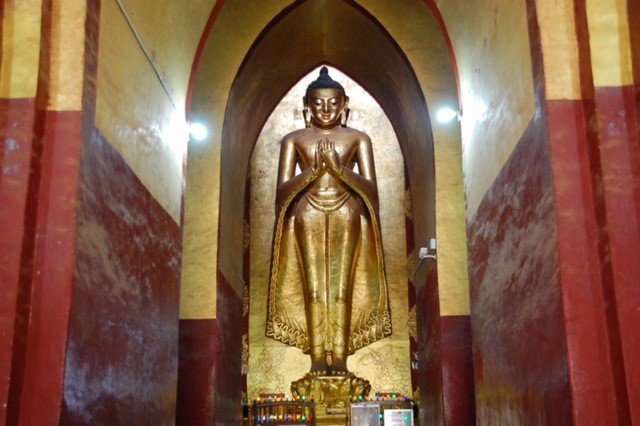
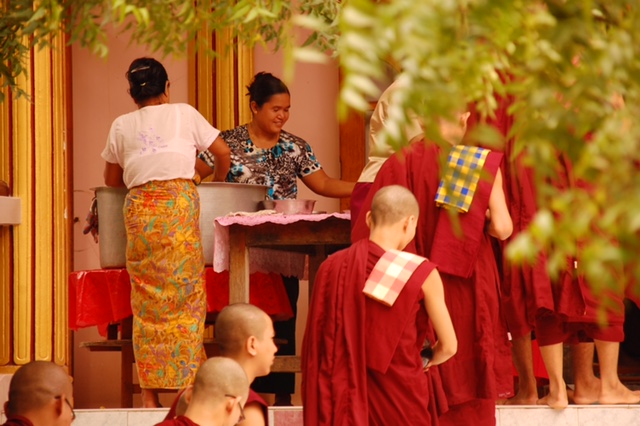
It is hard to reconcile the excesses of past military rule and now influence with the deeply spiritual Buddhist society. We visited monasteries and nunneries, we talked with young monks and novices and visited the schools they run for their young monks and for the poor. We saw them receiving donations of food and everywhere a culture of giving and generosity. Do no harm and build a portfolio of good deeds underpins the core society.

So once again in reaching a conclusion about what is happening in Rakine province you need to get deep within the history and politics of this nation. I am not sure I’ve reached a conclusion, and certainly the pictures and evidence shows what is happening is awful in the extreme. But I understand it better. Aung San Suu Kyi needs support- she wont have changed from the day she received her peace prize. She needs support both internally and internationally. Bravery needs some sort of guarantee and security.
Talking with my travellers this week we talked much about how our democracy is in jeopardy- let alone Myanmar’s. people have taken their freedoms for granted and so many now fail to exercise power and get behind the soundbites and fake news to reach an informed decision. We need to help our young people understand the world they live in and play a part. They can then be the change-makers and the people who can vote with confidence and fight for the values deep down we all hold and want.
For our part, this is what we strive for in Kunskapsskolan- ” to contribute to an education that empowers every student to master the challenges of today and to shape the world of tomorrow” . But first some deep understanding to be an educated person –
 Teaching and Learning Without Bounds
Great piece John. Such a difficult set of things to balance and understand.