
This weekend we commemorate the 70th anniversary of the D Day landings which proved to be the start of the end of the Second World War. It seems particularly auspicious this year being the 100th anniversary of the start of the First World War.
As I watch and read the coverage, you cannot be anything other than emotional at the individual stories. For me, I decided that I should research the lives of those Baumbers who made the ultimate sacrifice. Looking at their stories is a way to recognise the sacrifice they made that we might live in a free respectful democracy.
You cannot be anything but horrified by the conditions they endured and particularly, in the First World War, the incompetence and disregard of some of the leadership. But what was it for? Was it the war to end all wars?
We have just had our European elections. Personally I am ashamed that across Europe we have seen so much extremism campaigning and electing members of the parliament with express purpose of withdrawing and dismantling the Community. What is more the percentage of the electorate ( 35% in the UK), who voted is a disgrace. People fight and give their lives to be able to vote, or achieve democratic freedom. But of all weekends, we should remember that the reason why countries worked together to create the European Community, was to bringing us closer together so such conflict would have little chance of happening again. We should remember that people gave their lives and futures to challenge those dictators who created an atmosphere of hatred for those of different faith, different race and different sexual orientation. Now we allow our votes to elect people who either openly or subliminally exploit feelings of prejudice and selfishness.
That is not to say that those who now administer it have got it right; that they remember the grand purpose and grand mission of peace and tolerance. Seeking conformity and building overbearing bureaucracies across so many different countries has at times created a different mission and distant decision-making. Personally I think we need to work harder at making this work and not talk about leaving or radically changing the system. This requires heroism and selflessness. It requires us to celebrate diversity and reject prejudice. Not bad things to think about on D Day.
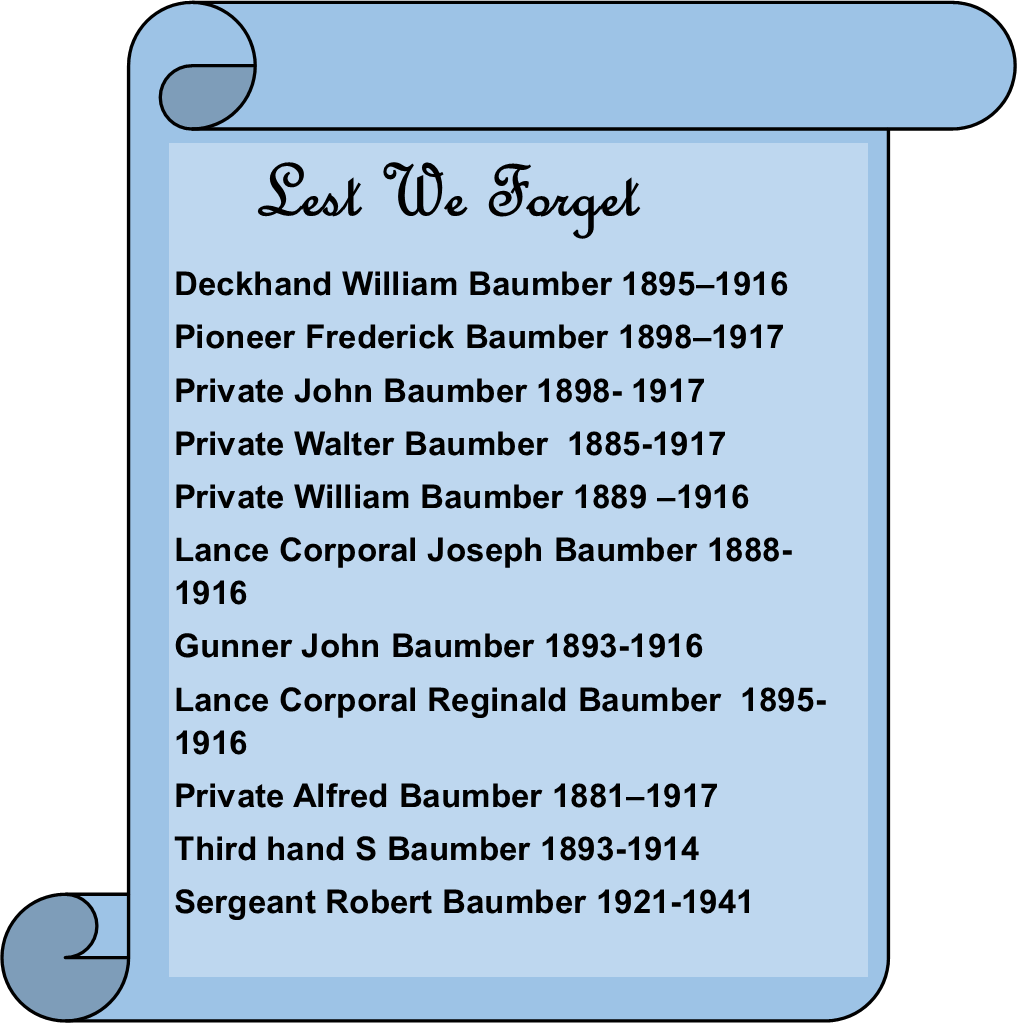 21-year-old William was a young fisherman from Grimsby who was deckhand on the trawler Tervani. The boat had been converted to a mine sweeper. On the fifth December 1916, three and a half miles offshore Orford Ness in Suffolk they hit a mine ant the boat foundered. All were killed. William was the second son of John and Annabella Baumber.
Two soldiers, Pioneer Frederick Baumber of the Royal Engineers and Lance Corporal Joseph Baumber of the 4th Battalion Lincolnshire Regiment contracted pulmonary tuberculosis and were discharged eventually dying in hospitals back in the UK. Both of their military records describe how the condition was aggravated by their service in the war.
Private John Baumber joined the 1st Division of the 4th battalion Lincolnshire Regiment. He was a farm labourer from Martin Dales in Lincolnshire. He died in November 1917 of his wounds having been involved in the second battle of Passchendaele. They had a most unenviable time. If they were not in the front line in the Polygon Wood area, they were furnishing large working parties for digging purposes. In camp there were air raids to worry them. On 26th October they moved up to the front line, which was then 1500 yards east of the Butte in Polygon Wood. The trenches were knee-deep in water. Here they spent 5 days of misery and when they came out of the line they had lost 9 men, 32 were wounded and 59 evacuated to hospital suffering from trench foot. On the 15th November they moved back up to the front after several days in railway dugouts. Rain fell heavily and again the trenches were waterlogged. This was a costly affair as the commanding officer was wounded with his two assistants killed. Five others including John were killed, a further 17 wounded and 2 missing.
Private Walter Baumber was with the 1st Battalion of the Kings Own Royal Lancaster Regiment. Private William Baumber his brother was with the 4th Division of the 1st Battalion of the Lincolnshire Regiment. William died of his wounds on 23rd April 1916 in Flanders. His brother died in action on 9th April 1917.
Walter was involved in the battle of Arras as was part of a diversionary expedition to enable a large attack in the French sector. After the initial success which saw the Canadians capture the Vimy Ridge.
William’s story was shared by many British troops. The battalion was in process of being relieved by 29th Battalion in the flooded crater field, when at 11pm on 5 April the German artillery opened a three-hour bombardment. At 3.30am next day, German infantry began to attack the by-now wrecked British positions, wire defences and badly mauled front line troops. British guns responded, but too late to halt the German infantry which quickly captured craters 2,3, 4 and 5. 31st Battalion held off the attack at Crater 6. Once secured, German artillery laid down a barrage around the position to stop any counter attack by the Canadians. Much confusion reigned, and in doubt as to which troops were in the craters British artillery did not fire on them. Local counter attacks using grenades failed to make headway. By 15 April, after a fortnight of heavy shellfire by both sides, it was clear that the four large craters in the centre of the original attack were now consolidated into the German front and the Canadian Corps took steps to consolidate in the front line that it held – back where things started, and still overlooked by the enemy.
Gunner John William Baumber was with the 88th Siege Battery, Royal Garrison Artillery in the early days of the Somme. These guns were used to bombard the German front line trenches and the main communication trenches while the 74th Siege Battery was sometimes seconded to counter-battery operations.
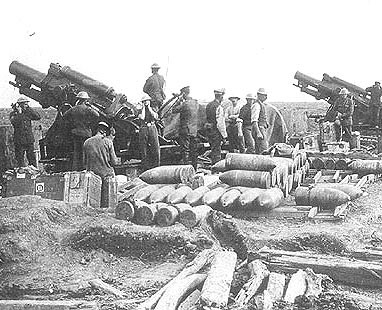
The description of the first phase of this battle gives some of the sense of what John was facing. “The British bombardment cut much of the wire at Gommecourt and demolished many trenches, particularly in the area of Infantry Regiment 170 opposite the 56th Division. The smoke-screen obstructed the beginning of the attack and the damage caused by the bombardment blocked many dug-out entrances; a counter-attack was swiftly mounted from Kern Redoubt (“the Maze”), which was not under attack. The counter-attack failed to stop the 56th Division reaching the third line of trenches, before a converging attack by Infantry Regiment 170, Reserve Infantry regiments 15 and 55 began. The British had consolidated and the counter-attack made little progress, until co-ordinated bombing attacks in the afternoon gradually recovered the position. Opposite the 46th Division, Reserve Infantry regiments 55 and 91 took post in time, engaged the attackers while they were crossing no man’s land and failed to stop the loss of the front trench, until a counter-attack from the third trench “annihilated” the leading British troops; the German regiments had 1,212 casualties. The 46th Division had 2,445 losses, the 56th Division had 4,314 casualties.
Lance Corporal Reginald Baumber from Grimsby was killed in action on 23rd October 1916 in Flanders whilst Private Alfred Baumber from Flixton, Manchester was killed on 23rd March 1917. Reginald died in the battle of the Somme and Alfred at Passchendaele, two of the most infamous battles. More than 600,000 men died at the Somme. Estimates of deaths at Passchendaele vary but probable count between a quarter and half a million. You don’t want to think about the number wounded and maimed.
It has been difficult to find the same detail about the two family members lost in the second world . Neither saw D Day. Sergeant Robert Charles of the Royal Air Force Volunteer Reserve died on 8th September 1941 and Gunner Robert Baumber died on 27th May 1940 probably as part of he Dunkirk retreat.
Today I salute their bravery and selfless commitment to fight for the values we live by.
As I watch the Normandy commemorations today and see world leaders from Putin to Obama, from Hollandes to Merkel, I only hope it will remind them of the importance of these values, or their responsibility to prevent prejudice and hatred, and to work collaboratively politically for the vision that founded the European Community and the United Nations. Lest they forget!

