Visits to South Africa always fill you with a mix of emotions, let alone challenge your view of the order of things. This week has been no different.
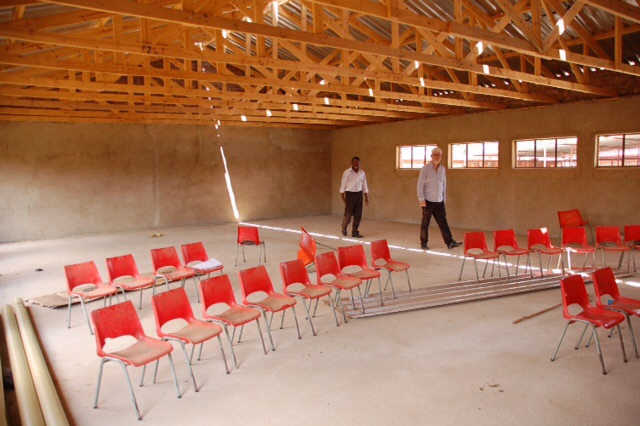
The first week was spent planning support for Bajabulile Primary School and teaching. We were able to hand over another 40000 ZAR which I think assures them that they will complete the very large Science Lab we are funding. It’s nearly twice as big as I expected and calculated the funding for. That’s great, given the class size they have of 40 +, but it has created quite a challenge to the fundraising. We have probably exploited all the support from friends and colleagues it would be reasonable to ask for. So now we have to find money for furniture and of course the resources.
The building is one thing. But as we know in other settings it will help, but it does not change anything without great teaching and learning strategies.
This is why when we go there we try and teach. We are trying to model some of the journey teachers will need to make. We are also reminding ourselves about the challenges they face each day. We work with between 40 and 70 students in a small classroom and at this time of the year in sapping heat. You can feel the fatigue kicking in by late morning. It is fine me talking to teachers about feedback and experiential learning, but with this number of students and the resourcing then it becomes really demanding. Hattie’s meta research shows that reducing class size has little impact on the success of learning. I don’t think he meant reducing from classes of 70 or even 40.
There are three classes in each grade, and we started helping grade 5s write letters of introduction to buddies in England and Sweden. We tried to use some of Ron Berger’s ideas about critique and redrafting. Given the number of students, this is a great way to encourage improvements in the quality of their work. It’s something -if they train students in the technique – that can make a real difference at all grades. We ended up with some beautiful letters – over 120 of them. Last year I asked for the teachers to send me some student letters about their ambitions. Although they were great letters what struck me was how the vast majority of letters referred to lost parents or brothers and sisters. If they did not have that experience, then they finished each letter by saying that they had a fatalistic view of their futures and so many said things like ” If I live…..
There was none of this in these letters. Rather the readers will be amused by some of the pet dog names – ‘Beast’, ‘Killer’ and the purely unemotional ‘Dog’.
We then moved onto Science and Maths lessons with grade 6. We bought the equipment for the experiment. The school has lots of bits of equipment, but for reasons stated above it gets no usage, and in many cases is not relevant to the curriculum or is a set of four or five pieces when you need 20. It was a simple experiment dissolving different types of sugar. We looked at the differences if we stirred or if the water was warmer. Problems?
Because teachers are moving from class to class through the day, and there are no additional staff as helpers or technicians, then you have no time to set up an experiment without losing valuable teaching time. Especially for 40 students in a small classroom. There were 4 of us and we still lost 10 minutes.
Students learn all sorts of practical skills if they have a curriculum which allows regular practical sessions. How to read a thermometer. Where to measure the volume and take account of the meniscus. So along with having the facility to perform practicals there has to be systematic skill development. Again we lost half the time in the lesson teaching the skills.
Because teaching is essentially a didactic exercise for all the reasons above, teachers have to be careful not to control the experiments so much that they end up doing it for them. Some of the students had everything they did, super controlled by the teacher. Fortunately with so many groups, one got measurements hopelessly wrong using 50 grams of sugar instead of 10. They made lovely paste. But what it did was allow for lots of discussion, and opened up a whole new experiment. Teachers have to let learners learn.
In both the Science experiment and the Maths lesson we wanted to emphasise the importance of hooking the learner into the exercise – making the learning real. So the science lesson was framed around making energy drinks quickly. The Maths lessons were set around a recipe for Black Forest gateaux. We walked into the lesson with a huge cake that immediately grabbed their interest. It was a session about fractions, decimals and percentages. They had to alter the recipe by using fractions etc. For instance, increase the flour by a quarter, reduce the sugar by an eighth. We did a WISKA (what I should know already) to start Enström,urging they knew how to add fractions with different denominators, and involving proper and improper fractions. All went well until they came to try and apply it to a real problem. This is where they need practice.
To be proficient in any subject and work efficiently you need to know stuff. However unfashionable it might be you need to know your tables. We saw lots of finger work which led to inaccuracy and time problems. They obviously know Maths operations but have they really learned it to a standard that they can apply it without thinking.
They enjoyed the cake though. I wouldn’t have wanted to teach the lesson afterwards with the 40 sugar rushes flowing.
The following day I had a half hour to talk with the teachers. It was an impossible task so I decided just to focus on one or two techniques listed above – impact, critique fir instance. I fired a water rocket by way of illustrating how you might get interest in physics and prompt questioning from students. What it taught me though was the need for a systematic teacher professional development programme to accompany this development. We need to arrange team teaching and model strategies when we are next here and I to the future.
But how? I talked with the acting head about the organisation of the school day, and how they might think radically about this to allow for teacher learning. I don’t know what the solution is but there is one in there.
Some of it will lie in the organisation of the new lab. It is to be arranged that there is more opportunity for dialogue. In addition to lab benches there are communication and group tables. One wall will be all whiteboard so that they can write up their ideas and show the rest of the group. There will be a projection facility so that they can project an idea or problem sheet without having to photocopy things 40+ times.
We have to do something about connecting them to the outside world. The media centre/library was set up as a school and community facility but it seems to have collapsed as a resource. It is the only place where wireless internet access is available an in a very limited sense. Kunskapsskolan have agreed to school access to the Learning Portal, but this will be a little wasted without the connection, and individual staff IT. Another task for the future.
The Minister of Education in the province has said that they want all schools to strengthen Science and Technology. It would be good to let them see what we are up to because this could be a showcase of how it could happen. Bajabulile just needs a little help from them.
And so….. The week at Bajabulile ends and we journey deeper into this amazingly complex yet beautiful country for a few days on safari in Pilansberg. In the comfort of the lodge at Black Rhino reserve, we see the other side of the country. Luxurious accommodation, plunge pool and wall to wall food. But above all we enjoy the most amazing game drives through this parched countryside set today at regular 4 – 38 degrees Celsius. Never mind the ‘Big Five’ in two days we see the ‘Magnificent Seven’ – elephant, lion, leopard rhino and buffalo plus cheetah and wild dogs!

It’s great to be able to enjoy this, but what a fantastic heritage tour this would be for Bajabulile and you know a two day trip staying at Bosele Children’s camp would not be an impossible amount to fund. I talked about impact earlier. Add to that awe and wonder and you’d have a recipe for fantastic Science!
We’ll be opening the centre mid February. Anyone wanting to help and come along are most welcome. You’ll have lots of awe and wonder moments. If you can’t come, then you can help in so many ways funding any element of the above. It’ll be your name in a little bit of Africa.

 Teaching and Learning Without Bounds
Tack John! Fantastic letter. Today I worked with Bergers model with critic. I will tell my students about the school in South Africa. Take care.
Pelle Eimar